The ocean is strongly layered, warm, light water sits on top, cold, dense water lies below, and between them there is a sharp transition zone where density increases rapidly with depth. This transition is called the pycnocline, and it acts as a barrier: it resists vertical mixing and largely determines how much heat, carbon, and oxygen the ocean exchanges between its surface and its interior.
There are actually two pycnoclines. The shallow one, the seasonal pycnocline, forms every spring and summer as the sun warms the surface, and disappears every autumn and winter as convection and storms mix it away. Below it sits the main pycnocline — deeper, more permanent, extending down to roughly a kilometre. This is the real and permanent barrier. And it has long been assumed to be static, varying over centuries, not years.
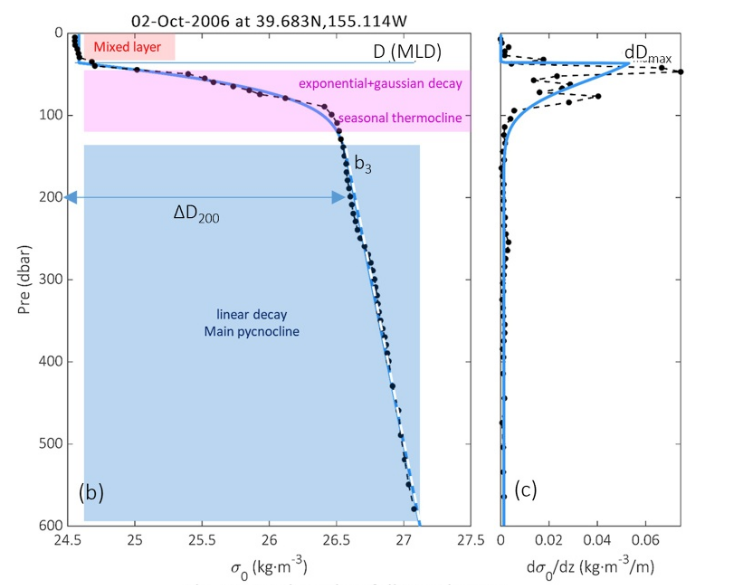 Example of an Argo float-derived density profile (black dots and line). Somavilla et al., 2026
Somavilla et al. show that assumption is wrong. Using two decades of Argo float data and more than two million density profiles spread across the global ocean, they demonstrate that the main pycnocline varies significantly and coherently on seasonal to decadal timescales. Its variability organises into well-defined spatial patterns that bear the unmistakable signature of the major climate modes — El Niño Southern Oscillation in the Pacific, the Indian Ocean Dipole, the Atlantic Niño, and their extratropical cousins the North Atlantic Oscillation and the Southern Annular Mode.
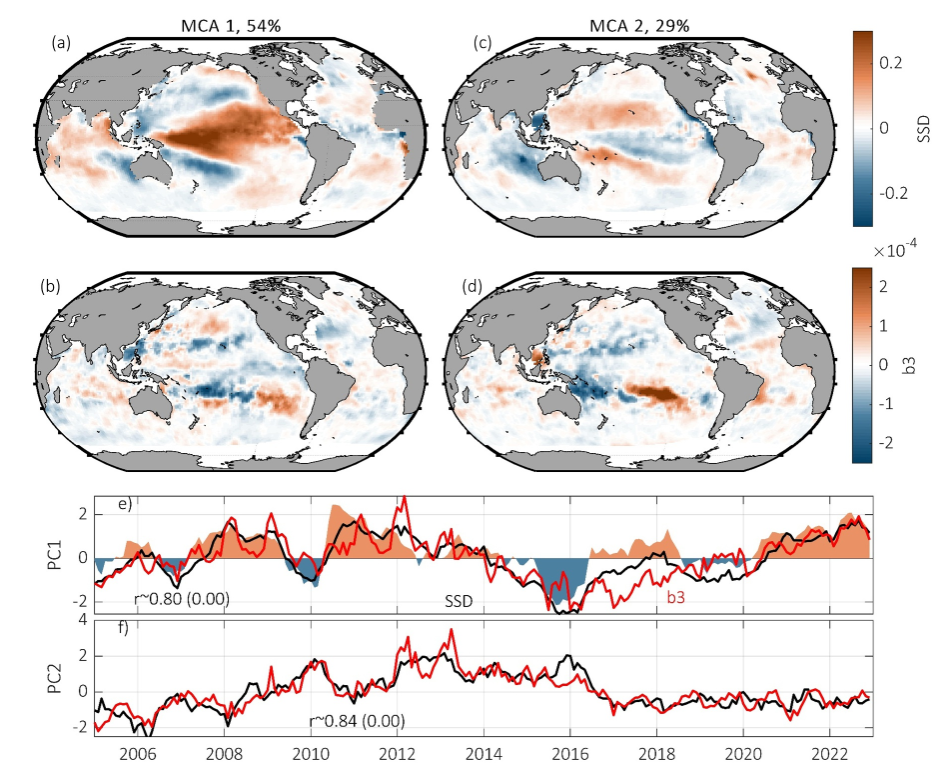 Linked patterns of surface density and main-pycnocline slope across the global ocean. The two dominant modes of co-variability (MCA1 and MCA2) capture how the surface and the upper-ocean structure vary together. Their time series track the ENSO cycle closely, confirming that interannual climate variability imprints all the way down to the pycnocline. Somavilla et al., 2026.
Annual, interannual and decadal climate variability reaches all the way down to the main pycnocline, leaving its fingerprint on the deep ocean’s vertical structure. But a fingerprint pressed into something as dynamic as the ocean does not simply sit there. As we initially mentioned, the pycnocline controls how the ocean stores and releases heat, how it feeds the surface with nutrients and oxygen, how it mediates the exchange between the ocean’s interior and the atmosphere above. It is not a passive recorder. So the question is open: if climate variability leaves its fingerprint on the main pycnocline, does that fingerprint return as a deep echo, shaping the very climate modes that shaped it?